Editorial Conversation
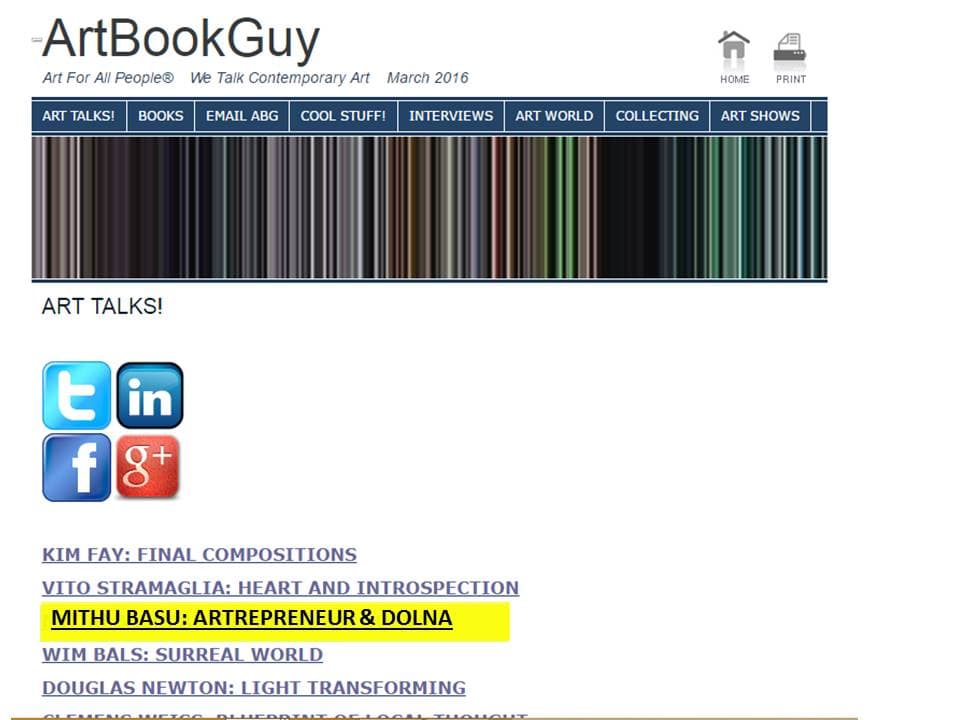
Mitu Basu in Conversation with Michael Corbin
A long-form exchange from ArtBookGuy: candid, thoughtful, and deeply rooted in Indian art, culture, patronage, and the philosophy behind Dolna Art.
Editorial Conversation
A long-form exchange from ArtBookGuy: candid, thoughtful, and deeply rooted in Indian art, culture, patronage, and the philosophy behind Dolna Art.
"Every artist deserves one fair chance to be seen. That is not a dream. That is the least we can do."
MICHAEL: You are in Mumbai -- colourful, overcrowded, super-energetic. Is it chaotic? What is it like there?
It feels great to be chatting with you. You have described Mumbai bang on. It is full of energy, ideas, dreams, hopes, and hopelessness -- a city of contrasts where people coexist amid glaring disparities. We call it the land of opportunity, because everyone gets a fair chance to make it or break it here.
By Indian standards, Mumbai is disciplined, but for a Westerner the sheer scale can be overwhelming. My father's posting brought us here when I was two, along with my nine siblings. To me, it is home, and I remain a die-hard fan. There is something in the air here that keeps people moving forward. Have I tempted you enough to come over?
MICHAEL: Many Americans still see India as an impoverished country. Is that true or is it changing?
That idea is as far from the truth as saying only 8% of Americans have passports. India is in an exciting phase. While global markets are talking of saturation, we are just opening up. The untapped potential here is enormous, and the world is already making a beeline for it.
As an artrepreneur, I see the growing openness to art as a sign of new winds blowing. The basics of food, clothing, and shelter are being addressed, and now we are ready to bring lifestyle, luxury, and art more fully into our lives.
"Authentic, affordable and original is the way forward."
MICHAEL: Are people in Mumbai's growing middle class buying art? Do they understand contemporary art?
The growing middle class is becoming the new art audience -- young, double-income, professional, well-travelled, and aspirational. They may not always understand art in the academic sense, but they understand its value, its presence, and often they invest simply because they love it.
I promote carefully chosen artists whose work carries the ethos of India. The expression may be contemporary, folk, or a fusion, but wherever it is seen, it should still feel rooted in India. Authentic, affordable, and original is the way forward.
"As an artist I believe that more than being understood, art must be felt." I have always felt that art works best when it is felt before it is understood. Creating is really about giving form to emotion, and when someone else connects with it, that is when the work truly begins to speak. The nine rasas feel so relevant because they remind us that human emotions are universal, even when we express them differently. That shared feeling is what makes art powerful.
MICHAEL: Tell me about your own relationship with art. How and when did this begin for you?
It began early. In grade two, we were asked to draw a flower that had been drawn on the board. I found it strange that a cut flower was meant to stand on its own, so I placed it in a vase and the vase on a table. The next day, the teacher singled out my drawing and asked who had done it. Her tone was not pleasant. I was scared, so I raised my hand.
Our principal, a soft-spoken German nun, asked me why I had added the vase and table. After hearing my explanation, she took me in her arms and said, "You will be an artist one day." I didn't catch it then, but it surfaced later in life, when I realised that art was my passion and being an artist was my calling.
I come from Kolkata, a city where creativity is part of the air you breathe. My mother's artistic sensibility and my eldest brother's guidance deepened that instinct. He was an artist himself.
THE BIRTH OF DOLNA
MICHAEL: What is Dolna? Is it an art startup? How does it work?
A celebrated designer friend once asked me what exactly I wanted to do. I told him, as a visual thinker, I saw artists sitting on my swing and being pushed higher. He immediately said, "Call it Dolna," which means swing in Bengali. It was short, memorable, and captured the spirit of the idea. Then I added that it was also my late mother's name. With her blessings, he designed the logo -- the upward arc with the red spot, almost like a mark taken from my forehead. I loved it.
"I see artists sit on my swing to get that push to fly high."
The spine of the work is to discover talent beyond the urban centres, while also working with articulate urban artists. I want to handpick artists whose work reflects the ethos of the country in content, style, symbolism, and palette, so that our identity stands tall in a fast-emerging, borderless world.
I also wanted to take art into spaces where it is not usually expected -- clubs, hotels, malls -- because in India, families rarely go to galleries together. I wanted children to encounter art early, artists to travel and gain new perspectives, and the art fraternity to dialogue and collaborate more openly. Above all, I wanted to make selling art more viable, so that it could become a sustainable career choice.
We are now in our sixth year, and the response has been encouraging. Our events have happened in unexpected spaces, our art retreats have taken artists across India and abroad, and our e-commerce website has carried Indian art to faraway walls around the world. We can celebrate what we have done, or recognise how much more still needs to be done. I believe in the latter.
MICHAEL: Do people really need art? We need air, food, water, shelter to survive -- but do we need art? What is the point?
The answer is in the question itself. Yes, the basics help us survive. But surely we were not meant only to survive. Unlike animals, human beings need refinement, sensitivity, imagination, emotion, beauty, joy, provocation, aspiration, inspiration, empathy, introspection, and perception -- all of which art can awaken.
As a visual thinker, I see it this way: we take air for granted, but a breeze makes us aware of its presence. In the same way, the universe around us is a tapestry of art, but we often overlook it. It is the artist, through work in any medium or discipline, who wakes us up to that reality and to the possibilities within it.
Creativity is what pushes invention, innovation, and progress forward. If we look at human history, we can trace the journey from the dark ages to modern times through the evolution of art. A picture still speaks more than a thousand words. That is what makes visual art such a powerful force That is what makes visual art so powerful. It lets us see ourselves, and the world around us, a little more clearly.
"universe with all its elements is a tapestry of art -- taken for granted like air. It is the artist who awakens our mind to its infinite possibilities."